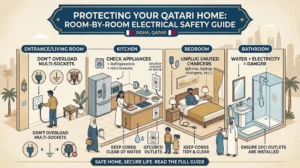
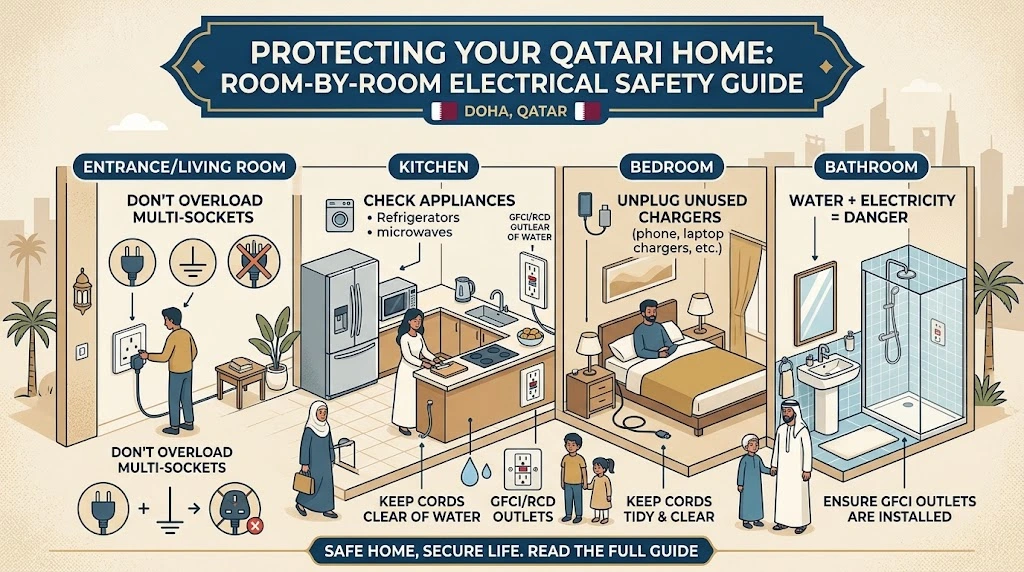
Quick answer: Test your RCD regularly, never overload sockets or extension leads, keep AC units and filters clean, keep water away from sockets, and let only a licensed electrician touch your wiring or DB board. Walk through each room looking for warm sockets, burning smells and flickering lights, and deal with them early.
Most people think about electrical safety only after something goes wrong: a breaker that trips at 2 a.m. in August, a socket that smells slightly burnt, a light that flickers and never quite stops. By then you’re already reacting.
This guide works the other way round. At Rahman Home Maintenance Qatar, we walk through a home one room at a time on every site visit, so we’ve written that walk-through down. It tells you what to look at, what’s normal, and what needs a professional. And it’s built on Qatar’s own rules and conditions: Kahramaa’s Low Voltage Electricity Wiring Code, plus Civil Defence and Ministry of Interior (MOI) advice, not generic tips written for a cooler, wetter country.
Why electrical safety in Qatar is different
Your wiring works in conditions the rulebook itself calls harsh. Kahramaa’s wiring code puts the average summer maximum at 45°C and the extreme at 52°C. It describes the air as salt-laden and very corrosive, notes that fine dust hangs in the atmosphere even on calm days, and records humidity as high as 100% at 30°C. Heat, salt, dust and damp all wear down insulation, contacts and breakers faster than they would elsewhere.
Then there’s the load. Run split ACs in every room for six months and your wiring spends the summer close to its limit. The MOI has linked the summer rise in fires to exactly that: long AC hours, overloaded sockets, appliances left running. Qatar Statistics Authority figures for 2011, the most recent cause-by-cause breakdown we could find, recorded 1,026 fires, with May the worst month at 124. The cause was identified in only a small share of them, and electrical short-circuits led those with at least 87 cases. Civil Defence’s 2026 summer update still lists overloaded electrical systems and ignored fault signs among the habits behind fires.
Numbers worth knowing:
- Supply: 240 V single-phase, 415 V three-phase, 50 Hz
- Civil Defence emergency line: 999
- Kahramaa call centre: 991
- Average summer maximum: 45°C; extreme: 52°C
None of this means your home is unsafe. It means the checks below matter more here than they would in London or Toronto. If you’d rather hand the whole job over, an electrician in Doha can go through the house in a single visit.
Start at the source: your distribution board
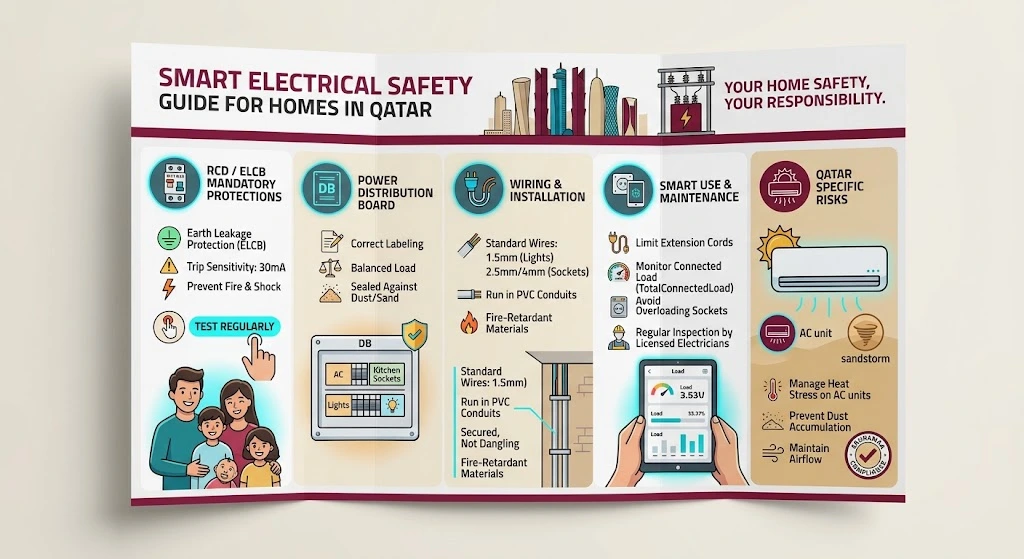
The DB board, the box of breakers usually by the entrance, in a corridor or in a store room, is the heart of your home’s wiring. Look at it before anything else.
- Where it sits. Kahramaa’s code says a DB must not be in a kitchen, bathroom or toilet, or under a staircase with less than 2 metres of headroom. Outdoors, it needs a fully weatherproof brick or concrete enclosure, and a wooden cupboard on an external wall isn’t accepted.
- Clear space. The code asks for at least 750 mm of clear space in front of a main switchboard and says not to use a switchboard cupboard for storage. Mops, boxes and Ramadan decorations belong elsewhere.
- A label on every breaker. Each DB should carry a laminated schedule showing what each breaker feeds. If yours is blank or faded, that’s a ten-minute fix, and it matters on the day you need to cut power to one room quickly.
- No rewireable fuses. The code bans them outright. If your board still has old fuse holders you re-wire by hand, it’s due for replacement.
- Heat. Breakers carry less current when they’re hot. The code tells designers to derate them to 80% of their rating in Qatar’s conditions unless they’re built for 50°C. A board in a sunny, unventilated store room can misbehave more than one in a cool hallway. If the casing is too hot to hold your hand on, get a proper DB board inspection rather than a quick fix.
How to test your RCD in 30 seconds
Your RCD (residual current device) cuts the power in a fraction of a second when current leaks to earth. That’s the difference between a dangerous shock and a tripped switch. Kahramaa’s code requires earth-leakage protection, and most home RCDs are rated at 30 mA. They can also fail silently, so test yours. Australian energy-safety regulators recommend every three months, and it’s a sensible habit here too.
- Turn off or unplug computers and anything sensitive.
- Find the RCD on your DB. It has a button marked T or TEST.
- Press the button. The switch should flip off straight away.
- Check that a lamp or socket on that circuit is now dead.
- Switch the RCD back on.
If it doesn’t trip, or won’t reset, stop using that circuit and book an electrician.
Room by room: what to check in your home
Living room and majlis
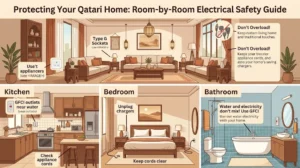
This is where cables multiply: TV, console, sound bar, lamps and chargers, all on one adapter behind the sofa. The MOI’s advice is plain. Use original wires and sockets that meet approved standards, and don’t overload extension cords. A good rule is one lead per wall socket, never a lead plugged into another lead, and nothing high-powered (heater, kettle, iron) on a multi-way adapter.
Two Qatar-specific points. Kahramaa’s code only allows floor-mounted 13 A sockets where the floor is carpeted, so a floor socket set into marble or tile is worth questioning. And cables under rugs get trodden on, trapped and heated, so bring them out into the open.
Feature lighting needs care too. Cove lights, LED strips and chandeliers in gypsum ceilings tuck drivers and transformers into tight spaces where heat can’t escape. If a ceiling light flickers or the fitting feels hot, have the circuit checked. Adding sockets or lighting points is a job for licensed electrical wiring and rewiring, not a weekend project.
Bedrooms and AC
Air conditioners are the biggest single electrical load in most Qatari homes, so look here early. Each split unit should have its own fixed supply and isolator, not a plug into a multi-socket. Clean the filters often: the MOI has warned that dust settling on AC components raises the risk of overheating and short circuits. Before bed, switch off ACs in rooms nobody is using and unplug chargers and consoles, which is also MOI advice. Buy original chargers; cheap ones are a common fire starter.
Thinking of adding another AC? Kahramaa’s code requires prior approval for alterations to an installation, and for any increase of more than 10% in a property’s connected load. “Just plug in another split” isn’t how it works.
Kitchen
Heat, grease, water and a lot of high-wattage appliances: the kitchen has everything. According to Qatar Insurance Company, most home fires in Qatar start in the kitchen, often from unattended cooking or old electrical appliances.
- Give the oven, microwave, kettle and air fryer their own wall sockets. None of them should share an adapter.
- Clean exhaust fans and vents. The MOI warns that grease builds up in them, and that fans left running all day heat their wiring.
- Check under the sink. A slow drip next to a socket or a wire is both a plumbing and an electrical problem, and a proper leak detection and repair visit finds it before it finds the wiring.
- Keep the fridge socket reachable. If you can’t get to the plug, you can’t isolate it.
Bathrooms and laundry
Water and electricity: respect the combination.
- Water heater earthing. Kahramaa’s code requires a green-and-yellow bonding lead (minimum 2.5 mm²) from the heater’s earth terminal to the hot and cold metal pipework. It’s the kind of detail that gets skipped in a rushed install, so if your heater was fitted without anyone mentioning earthing, ask for it to be checked. Our water heater services include exactly that.
- Sockets. The only socket a bathroom should have is a proper shaver socket. Hairdryers and straighteners live in the bedroom.
- Washing machine and dryer. Use a wall socket, not an extension lead, and check the cable isn’t trapped behind the machine.
- The wet rule. If a switch or socket has ever got wet, stop using it until an electrician has checked it.
Outdoors, garden, pool and roof
Qatar gets only about 50 mm of rain a year, mostly between January and April, according to Kahramaa’s code. So outdoor lights and sockets sit idle for months and then meet a downpour. Check these before the cold season:
- Outdoor sockets and lights need weatherproof covers and sound gaskets. The code requires anything exposed to weather and corrosive air to be protected accordingly, and cables on exterior surfaces to be shielded from direct sun.
- Around the pool, Civil Defence advises safe electrical installations and lighting and keeping electrical devices away from water.
- Garden lights, pergolas and majlis extensions need proper outdoor-rated cable. An extension lead run through the window doesn’t count.
For the full outdoor checklist, read our guide to electrical safety during rain.
Warning signs: when to stop and call
Some signs are the house telling you something. Here’s how seriously to take each one:
| What you notice | What it can mean | How urgent |
|---|---|---|
| Burning smell, smoke or sparks at a socket, switch or DB | Overheated connection or arcing | Emergency |
| Plug or socket warm, brown or discoloured | Loose contact or overloaded circuit | Same day |
| Tingle when touching an appliance or tap | Earth fault | Urgent: stop using it |
| Exposed or damaged wires, cracked sockets | Insulation failure | Urgent |
| Buzzing or crackling | Loose connection or failing component | Same day |
| Lights dimming when the AC starts | Loose connection or heavily loaded circuit | Book a check this week |
| RCD that won’t reset | Leakage fault somewhere on the circuit | Same day |
If there’s smoke or fire, or someone has had a shock, call Civil Defence on 999. For supply faults and problems on Kahramaa’s network, the number is 991. For everything in between (the dead socket, the warm plug, the burning smell you can’t trace), our emergency electrician service handles same-day call-outs across Qatar.
Who is allowed to work on your wiring?
In Qatar, not you, and not a handyman with a screwdriver. Kahramaa’s code says work on electrical installations may only be carried out by licensed contractors. Kahramaa has also asked the public not to tamper with installations or attempt their own repairs of electrical faults.
In practice: don’t swap sockets, extend circuits or open the DB yourself, and ask any electrician who quotes for your home to confirm their licence. If you rent, report problems to your landlord or property manager first. Changes to a building’s wiring aren’t a tenant’s decision.
A simple electrical safety routine
- Every month: feel a few sockets for warmth, tidy loose cables, clean AC filters through summer.
- Every three months: press the RCD test button.
- Before summer (April to May): service the ACs, check the DB is labelled and unobstructed.
- Before winter rain (December): check outdoor sockets, lights and covers.
- Every few years: have a qualified electrician inspect the installation. Qatar Insurance Company suggests this especially for villas over 10 years old.
- Any time: replace appliances with damaged cords, and don’t leave devices running or plugged in when you’re away.