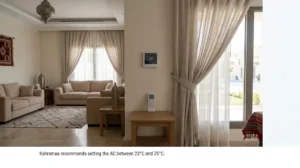
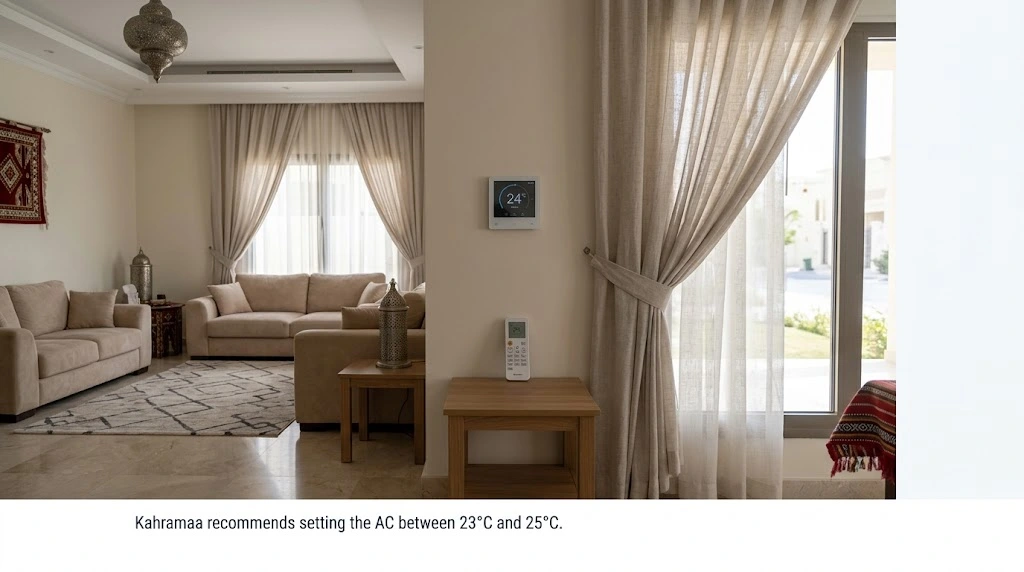
The fastest way to reduce your electricity bill in Qatar is to start with the air conditioner. Kahramaa says AC units use 50–75% of the electricity in a typical home. Set them between 23°C and 25°C, clean the filters every two months, keep doors shut and curtains closed, and switch off cooling in rooms nobody is using. Lighting, the water heater and heat coming through walls come next.
That is the short version. The rest of this guide shows where the kilowatt-hours actually go, what to change first, what each change is worth according to Kahramaa’s own figures, and which jobs are worth handing to an electrician. It is written for villas and apartments in Doha, Lusail, Al Wakrah, Al Rayyan and the rest of Qatar by the electrical team at Rahman Home Maintenance.
Last checked 25 October 2026. Savings figures come from Kahramaa’s Tarsheed programme and the sources listed at the end.
Why your Kahramaa bill jumps in summer
Cooling is the reason. From May to September the AC runs for most of the day, and in a villa with several split units it can run for most of the night too. Kahramaa bills electricity in tiers, with higher-use brackets charged at a higher rate per unit, so a very hot month can cost more than the extra kWh alone would suggest.
The tariff itself differs by customer category and is updated from time to time, so we don’t print rates here. Our Kahramaa electricity tariff explainer walks through the slabs, and the tariff tools on km.qa always show the current figures for your premises.
Where the electricity goes in a Qatar home
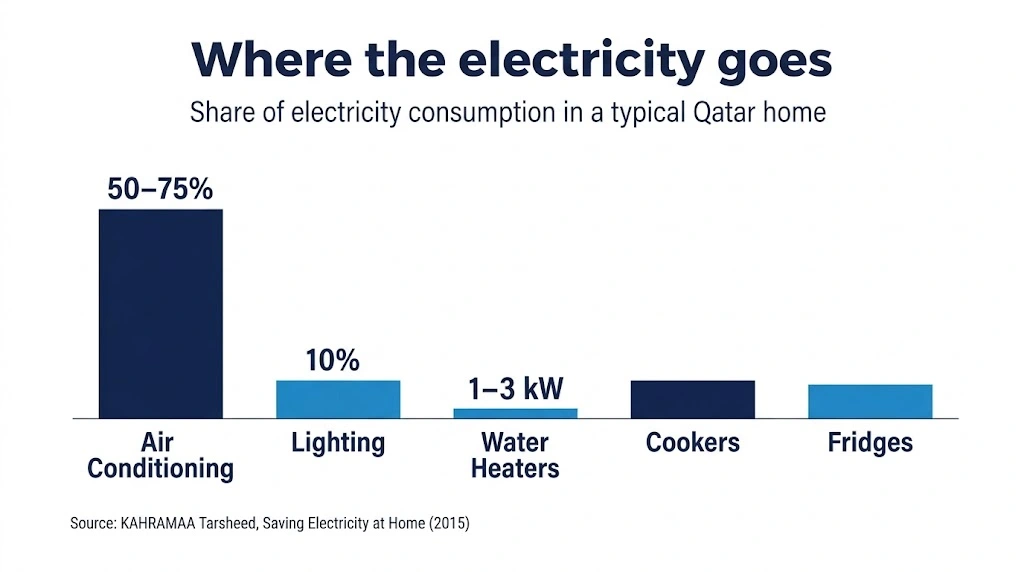
Before you change anything, it helps to know which appliances deserve your attention. This is what Kahramaa’s Saving Electricity at Home booklet says about the big loads.
| Load | What Kahramaa says | Best first move |
|---|---|---|
| Air conditioning | 50–75% of the electricity used at home | Thermostat at 23–25°C, clean filters, doors closed |
| Lighting | About 10% of the electricity in a building | Switch to LED, add timers and sensors |
| Electric water heater | A 1–3 kW load, similar to an 18,000 BTU window AC | Set to 60–70°C, switch off in summer when not needed |
| Electric cooker | A large load when hobs and oven run together | Avoid using both at once, avoid 12 PM to 5 PM |
| Fridge | Hard to cut, but placement matters | Keep 15 cm from the wall, away from direct sun |
The booklet dates from 2015, so treat the percentages as a guide, not a measurement of your home. Your own meter is better evidence, and for a ranked list of everyday appliances you can read our guide to which appliances use the most electricity in Qatar.
Step zero: find out what you actually use
Get a baseline first, otherwise you won’t know whether anything worked. Log in to your Kahramaa account on the website or app and note your consumption in kWh, not only the amount due. Compare this month with last month, and this August with last August. If you can see daily usage, write down a few ordinary days before you change anything, then check again after each step below.
If you are not sure how to read the numbers, our guide on how to read your Kahramaa bill and meter goes through it line by line. And if the bill has jumped with no change in habits, call Kahramaa’s 24-hour contact centre on 991, or message them on WhatsApp at 30303991. A faulty appliance can quietly use far more power than it should, so it is worth ruling that out early.
1. Air conditioning: the biggest lever
Everything here comes from Kahramaa’s own advice, and most of it is free.
- Set the thermostat between 23°C and 25°C. That is Kahramaa’s recommended range, and a higher setting means lower consumption. Setting it much lower does not cool the room any faster. It just keeps the compressor running longer.
- Don’t run the AC when it is 25°C or cooler outside. This matters right now. On the cooler days that arrive from October, open the windows or use a fan instead.
- Use a fan at the start of summer. A fan costs a fraction of an AC to run and takes the edge off before the real heat arrives.
- Clean the filters at least every two months. Kahramaa says dirty filters raise consumption by about 5%. It also recommends a full service once every six months.
- Keep doors closed and curtains drawn on sunny sides. You are paying to cool the room, not the corridor.
- Check where the units are fitted. Kahramaa advises against installing AC units near windows, under skylights or in tight spaces, because poor ventilation around the unit raises consumption. Worth knowing before you move one.
- Give each room its own switch and thermostat. Kahramaa recommends this so you can stop cooling rooms you aren’t using. Adding a proper isolator switch or a separate control is a job for an electrician, and our electrical services team does it as part of a visit.
- Switch cooling off in empty rooms, and when you travel. Guest rooms, storerooms and a majlis that is used twice a month don’t need to stay cool all summer.
- When you replace a unit, pick an efficient one. Kahramaa says a high-quality, efficient AC saves 16–40% of your consumption. Ask the seller for the approximate yearly running cost before you buy.
One warning. If an AC keeps tripping the breaker, don’t keep resetting it. That is a wiring or distribution board question, not a settings question. See our page on DB board and circuit breaker repair for what we check.
2. Stop the heat getting in
The cheapest unit of electricity is the one your AC never has to use. Kahramaa says the heat that comes through walls and ceilings is more than 60% of what air conditioners are working against in summer, and that good thermal insulation can cut consumption by up to 40% and keep walls around 8°C cooler than uninsulated ones. Gaps around windows, doors and ventilation openings let the cooled air out and the heat in.
Insulating a whole villa is a building-level project, so start with what you can do this week:
- Layer your curtains. A sheer panel for daylight and a blackout or dim-out layer for the sun side keeps direct heat off the glass. We make and fit layered curtains through our curtains, carpets and sofas service.
- Seal the gaps. Door bottoms, window frames and the openings around AC pipes are the usual leaks.
- Think about glass and roofs when you renovate. Insulated windows and roof insulation are far cheaper to include in a renovation than to add later.
3. Lighting: a small share, but an easy win
Lighting accounts for roughly 10% of a building’s electricity, so it won’t transform your bill, but it is cheap to improve. Kahramaa’s figures:
- Energy-saving lamps use about 20% of the power of old incandescent bulbs for similar light.
- Motion or light sensors can cut lighting use by around 40%.
- Light-coloured interior paint reflects light, so a room needs fewer lamps. Our painting team can repaint a dark room in a lighter shade if you are redecorating anyway.
- Dust on fittings and shades reduces light output, so wipe them.
Outdoor lights have a legal side. Kahramaa’s booklet cites Law No. 26 of 2008, which says lights fixed to walls and external facades must not be left on between 7:00 am and 4:30 pm. Coverage in 2017 quoted a Kahramaa official warning of fines of QR10,000 for leaving them on. Check the current rules with Kahramaa, but a timer or photocell on your gate, boundary-wall and facade lights solves the problem and saves power at the same time.
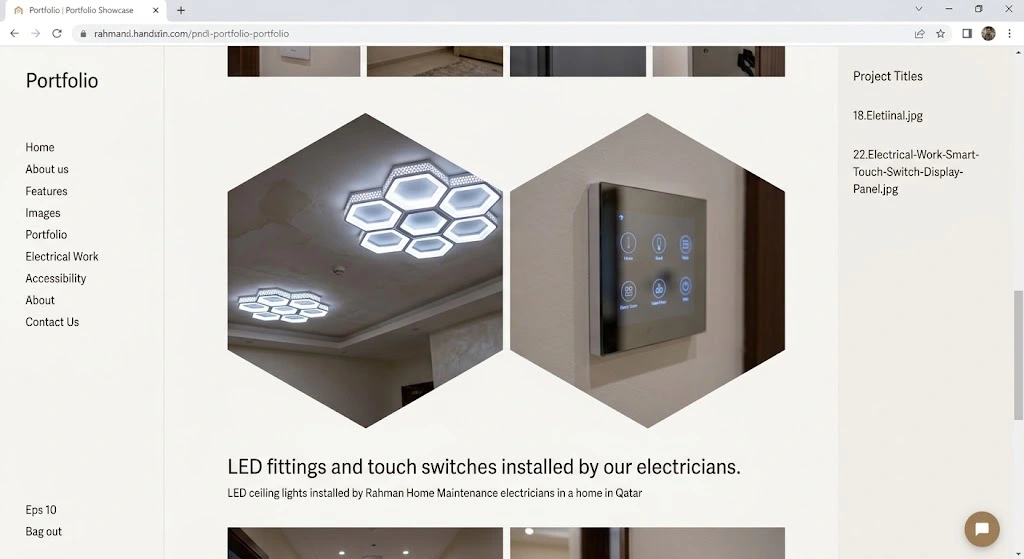
Fitting LED lamps, sensors, timers and touch switches is routine work for our electricians. If your villa still has old halogen downlights, ask us to quote for a swap.
4. Water heater, cooker and fridge
Water heater. A typical electric water heater draws 1–3 kW, which Kahramaa compares to an 18,000 BTU window AC. Kahramaa’s advice, including on its FAQ page, is not to use the water heater in summer unless you need it. If you do, set it to 60–70°C, make sure the thermostat and the safety valve work, repair any leaks in the hot water pipes, and clean the tank regularly. Solar water heaters are the long-term fix. If your heater is old, struggles to heat or keeps tripping, our plumbers and electricians handle water heater repair and installation together, which saves you chasing two trades.
Electric cooker. Avoid running the hobs and the oven at the same time, and avoid cooking between 12 PM and 5 PM when the grid is under most strain and your kitchen is hottest.
Fridge. Keep it at least 15 cm from the wall so the compressor can breathe, away from direct sunlight and the oven. Don’t put hot food straight in, and don’t set the thermostat colder than you need.
5. Small habits that add up
None of these is dramatic, but together they matter in a house with several people:
- Switch off lights, TVs and fans in empty rooms.
- Use daylight where you can.
- Unplug chargers and idle devices, or put them on a switched strip.
- Run the washing machine and dishwasher on full loads.
- Teach everyone in the house, including helpers and children, which switches matter most.
A simple order of work
If you only do one thing from each row, you will already be ahead of most households.
| When | What to do | Effort |
|---|---|---|
| Today | Set AC to 24°C, close doors, draw curtains on the sunny side, note your kWh | Free |
| This week | Clean AC filters, seal obvious gaps, put outdoor lights on a timer, switch off the water heater if you don’t need it | Low |
| This month | Service the ACs, swap old bulbs for LED, add per-room AC switches, check the water heater thermostat | Low to medium |
| Next upgrade | Efficient AC, insulated windows and roof, solar water heater | Higher, but largest long-term effect |
When to call an electrician
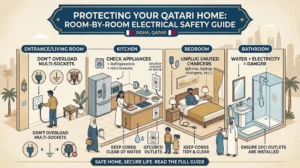
Most of this guide needs no tools. A few jobs do, and they are not for DIY: new circuits or isolator switches, timers and sensors wired into lighting, a switch for the water heater, and anything inside the distribution board. KAHRAMAA’s wiring code requires electrical installation work to be done by licensed contractors, and mistakes with wiring are a fire risk. Read our guide to electrical safety at home in Qatar before you open a socket or a panel.
Rahman Home Maintenance’s electricians fit lighting, switches and sockets, appliance connections, distribution boards and wiring across Qatar. The site visit is free, and you get a written quote before any work starts. Send a photo of the problem on WhatsApp and we will tell you what it involves.